• Skip to primary navigation
  • Skip to main content

Signature Fiberglass Pools Chicago Swimming Pool Builder Illinois

Fiberglass Swimming Pool Builder serving Chicago and Illinois

(630) 845-1145 info@signaturepoolschicago.com
  • Pool & Spa Models
  • Pool Info
    • Pool Pricing
    • Pool Buying Process
    • Why Fiberglass?
    • Patio/Deck Options
    • FAQ’s
    • Downloads
  • About Us
  • Gallery
  • Contact
  • Receive an Estimate
  • Show Search
Hide Search

fiberglass pools

Where should I put my pool equipment? 5 things to consider

SignaturePools · Jul 8, 2010 ·

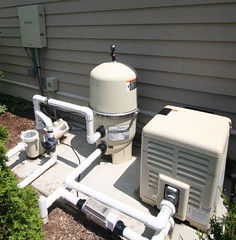
pentair equipment padSo you’ve decided to get an in ground pool. Great! Now the fun part begins: Picking all the fun stuff to go with your pool. Slides, water falls, fountains, and jets are just some of the options available with your pool. But before any of that gets picked out, consider the location of pool equipment needed to circulate, filter, and sanitize the water. Many homeowners have a set vision in mind. They can already see where the pool is going long before considering the limitations of their property and municipal codes. Here are several things to consider when deciding where to place your pool equipment.  Keep in mind that a basic equipment pad requires an area of approximatly 4′ x 8′ to accommodate a pump, filter, and heater.

1. Take a look at your Plat of Survey

The plat of survey is a document showing the exact location of your home, property lines, building setback lines, utility easements, flood plains, or any other special feature unique to your property. In general, you cannot install your pool equipment beyond any of these setback lines.  If you’re currently in the research phase of buying a new pool it is essential that you have a copy of your plat of survey to give to your sales representative. 

 2.  City, Village, or County Building Codes

As a general rule your pool equipment must be a minimum of 10’ from the water’s edge of the pool.  If you’re installing a heater with your pool (98% of our clients in Illinois do) you need to consider the distance between any windows and the exhaust vent on the heater.  Most municipalities require a 4’ minimum distance between the pool heater exhaust vent and any windows or window wells on the home.  For any other specific codes regarding pool equipment location you can contact your sales representative or your local governing municipality.

 3.  Association Requirements

These days many home owners associations have specific requirements as to the location of the pool equipment.  For instance, some associations won’t allow it on the side of your house.  Other associations want to make sure it is a certain number of feet off of your property line.  If you’re currently in the research phase of buying a new pool we highly recommend getting a copy of any association requirements prior to meeting with any sales representative. 

4.  Ease of Access

 Make sure the equipment will be located in a place with easy access as well.  If you purchase a remote with your pool you won’t be spending as much time at your equipment pad, but you will still want it to be in a reasonable place for maintenance and service.  If possible we recommend keeping your equipment within the fenced area of the pool.  This too will make it much easier to access your pool equipment.  If it’s not possible for the equipment to be installed within the fence area we highly recommend adding a gate close to the pool equipment.

 5.  Think About Noise

When you are deciding where to place the pool equipment, keep in mind the noise factor! Even with new variable speed pumps or 2 speed pumps the pump noise can be a nuisance if you’re equipment is too close your pool or any entertaining area around you pool.  If possible you also want to avoid installing the pool equipment right outside of a bedroom or any room of the house that is often used.

 I know this information seems a bit overwhelming- but here’s the good news: Signature Pools and Spas has installed over 400 swimming pools in the Midwest and we are familiar with what works and what doesn’t…in all types of backyards! We are also familiar with local code requirements and municipal regulations and can help you determine the best location for your swimming pool and equipment. If you have questions or would like further information about pool locations, please feel free to contact Signature Pools and Spas at 630.845.1145

How do I balance pH in my fiberglass swimming pool?

SignaturePools · Jul 6, 2010 ·

pH Down
Part of what we do at Signature Pools, along with building fantastic in ground fiberglass swimming pools, is teaching our clients about the importance of maintaining their pool water chemistry.  Many people have the impression that fiberglass pools are COMPLETELY maintenance free, and because of a salt water chlorine generating system, they don’t need to test or balance other pool chemicals.  Although it is true that fiberglass pools are much easier to maintain than concrete or vinyl in ground pools, there are still a few things to keep an eye on throughout the week.


pH LEVELS ARE CRITICAL TO THE CLAIRTY OF YOUR POOL WATER AND LONGEVITY OF YOUR POOL EQUIPMENT.

By far the most important factor in keeping the overall health of your pool is the pH, or degree of acid or base in the water.  pH is measured on a scale from 0 to 14 with 7 being neutral. 

Pool water pH is best kept in the 7.2 to 7.8 range.  When pH remains below 7.2, the water is considered to be corrosive and can damage metals in the equipment such as heat exchangers or lights.  It is also more difficult to keep chlorine in the pool because it becomes much less stable and is consumed faster than would be used at normal pH levels.

Keeping the pH higher than 7.8 will increase the tendency to form scale or cloudy water.  Calcium is an unstable mineral and when pH is high, the calcium has a hard time dissolving in the water.  High pH will also reduce chlorine effectiveness resulting in the need to maintain higher chlorine levels to achieve proper sanitation. Be aware that using a salt water chlorine generator will naturally increase the pH of your pool water and will need to be adjusted more frequently than when using stablized chlorine.

If pH levels are low, sodium carbonate (pH Up) is added to raise the pH.  If the pH is high, ph Down is used.  pH Down comes in two forms: liquid acid (muriatic acid) or dry acid (sodium bisulfate).

By keeing a close watch on your swimming pool pH levels, you will have a more enjoyable, safer, and easier to maintain environment in your backyard! If you have further questions about the pH of your pool water, or would like any other information about maintaining your pool, please feel free to contact us or call Signature Pools and Spas at 630.845.1145

Which is better a Chlorine Feeder or a Salt Generator?

SignaturePools · Jun 13, 2010 ·

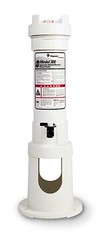
chlorine feederPentair IntelliChlor

One of the most exciting advancements in residential swimming pool technology has been the development of salt water chlorine generators.  This type of system works on vinyl and concrete pools but is expecially effective on fiberglass swimming pools and makes them even easier to maintain.  These systems are used as a replacement to an in-line chlorine feeder that sanitises the pool water. But, as with anything ‘new and improved’, there are pros and cons to the products and a few common misconceptions.  Here are a few things to keep in mind when deciding which kind of sanitation to use on your fiberglass swimming pool.


 Chlorine Feeder: Cons

-Uses processed chlorine tablets that dissolve into your pool water

-A manual hand valve is used to control amount of chlorine put into the pool

-Chlorine may cause unpleasant odor, uncomfortable skin and eyes, and faded bathing suits

-Tablets must be added to unit continually throughout the season

Chlorine Feeder Pros:

-Chlorine is being added to the pool as long as filter pump is running

-Unit does not need to be cleaned or serviced throughout the season

Misconception: Chlorine feeders are expensive  because the tablets need to be replaced all the time.

Truth: A typical fiberglass swimming pool owner in the Midwest will spend between $100-$200 for a year supply of chlorine

Salt Water Chlorine Generators: Pros

-Chlorine is produced in its natural state and added into the water.

-No detectable taste, odor, or discomfort on skin.

-Chlorine level is controlled electronically

Cons:

-Salt level in the pool must be maintained within a certain range in order for unit to produce chlorine

-Cell must be acid washed several times a year to remove mineral deposits

-Chlorine is only produced when pump is in high speed

-Cell can deteriorate over time and will need to be replaced

-Stabilizer must be added to pool water to help prevent chlorine burn-off from sunlight

Misconception: Chlorine generators provide a completely automated system and no other chemicals need to be checked in the swimming pool.

Truth:Even though chlorine is produced by the cell, all other chemicals- pH, Alkaline, Stabilizer etc- need to be tested and regulated manually.

The decision is ultimatly up to the customer to decide.  We at Signature Pools highly recommend salt water generators to our clients because of the ease of use and resulting water condition of the pool.  However, these systems are not for everyone and do not replace the need for regular chemical checks.  If you have any questions about chlorine generators or in-line feeders, please feel free to contact Signature Pools and Spas at 630.845.1145.

There is air in my pool pump

SignaturePools · Jun 2, 2010 ·

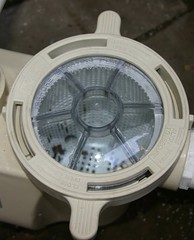
Pentair pump lid

This past week we have received several calls from customers asking about their pool pumps. In many cases they are not able to prime the pump completely or it looses prime when turned off. Here are a few things to look for if you come across this issue yourself.

1. Pump Lid- Make sure the lid for the pump is seated correctly and tightened all the way. Also check and see that the gasket between the lid and pump housing is in place and lubricated. A damaged, worn, or misaligned lid or seal can cause the pump to suck in air- preventing a full prime.

2. Skimmer and pump basket-check both the basket in the skimmer and inside the pump housing to make sure they are sitting correctly in place. A skimmer basket should align flush to the bottom of the skimmer pot. The pump basket should always be seated in the bottom of the pump. Many pump manufacturers such as Jandy and Pentair have a notch in the top of the basket that lines up with a grove inside the pump.

3. Water Level- make sure the water level is high enough in your pool. If it’s too low, air can be sucked through the skimmer and into the pump. Over time, this air can damage your pool equipment.

4. Loose pump union- check the threaded plumbing on the front of your pump. A loose union fitting may be allowing air to leak into the pump. Make sure to also check that the gaskets between the union fittings are also seated correctly and in place.

Preventing air from leaking into your circulation pump is important to keeping your pool equipment working well for years to come. If you have any questions about pool pumps, or any other pool equipment and maintenance, feel free to contact us at Signature Pools or call 630.845.1145.

What is wrong with my chlorine generator?

SignaturePools · May 28, 2010 ·

Pentair IntelliChlorSo your pool is up and running and the kids are ready to jump in the cool, refreshing water- but there’s a problem!  The pool water is all cloudy, maybe even green!?!  What gives?? You have a chlorine generator…no chemicals needed, right?

Not exactly….

Many pool owners have a misconception about what their chlorine generator (salt system) actually does.  Here are a few ground rules to keep in mind when maintaining your system.

1. Salt Level:  Make sure the NaCl (salt) is at the proper level in your pool water.  This measurement is made in parts-per-million (ppm) and should normally range between 2700 ppm and 3400 ppm.  Your pool equipment should have either a light indicator or internal digital salt tester to let you know if the level is correct.  If you have doubts about the accuracy of the equipment, use an independent testing agent to verify the results.  An easy test strip available from your local pool supplier will do the trick.  I personally like the AquaCheck brand for ease of use.

2.  System Diagnostics:  Once you verify the proper salt level in your pool water, you may want to run a quick diagnostics check of the salt cell to make sure it is running properly.  Most chlorine generator systems have a diagnostic mode that will measure the current that is running through the cell.  This will indicate whether or not the system is functioning properly.

3.  Clean the Cell:  Over time, calcium and other minerals will collect on the internal fins of the salt cell.  By cleaning the cell with an acid solution you will boost and extend the performance of the chlorine generating system.  Refer to your owners manual and manufactures’ recommendations for this process because every system is different.

 ALWAYS USE CAUTION WHEN HANDLING ACID AND OTHER POOL CHEMICALS!

4. Test your chemicals:  Many people think that having a chlorine generator means they don’t have to worry about chemicals for their pool AT ALL.  This is simply not true!!!  Staying on top of pH, Alkaline, and Stabilizer will greatly enhance the performance of your chlorine generator.  If these other levels are out of balance you may not be producing enough chlorine to safely sanitize the pool water.

Follow these simple steps to make sure your salt water pool runs smoothly, safely, and effeciently all season long.  If you have further questions about chemicals, or would like to speak to us directly, please feel free to contact Signature Pools and Spas, Inc or give us a call at (630) 845-1145.

  • « Go to Previous Page
  • Page 1
  • Page 2
  • Page 3
  • Page 4
  • Interim pages omitted …
  • Page 7
  • Go to Next Page »

Copyright © 2025

  • Home
  • About Us
  • Pool Info
  • Blog
  • Gallery
  • Testimonials
  • News
  • Contact Us